As seen in San Diego Health Magazine
Farrah Adams encourages women to put health first
A cervical cancer survivor shares her journey and why she urges women to prioritize screening, checkups and HPV vaccination.
Farrah Adams knew something wasn’t right.
The then-46-year-old had a persistent dull ache in her lower back that her massage therapist suggested might be caused by the way she sat or drove. That explanation seemed reasonable, but after experiencing heavy, painful periods for two of the past three months, she wanted answers.
When she looks back on it now, she’s beyond grateful she trusted her gut. “People — especially women — we innately justify these little symptoms,” she says.
Her primary care doctor ordered an ultrasound, which revealed what appeared to be uterine fibroids, benign growths on the uterus that can cause heavy menstrual bleeding. That would have explained some of her symptoms, but Farrah wasn’t convinced.
“For some reason, I wasn’t OK with that explanation,” she says. “Your body intuitively tells you things. My body was pushing me to keep digging.”
She made an appointment with a Scripps OB-GYN, who ordered additional testing, including biopsies on her uterus and cervix. Farrah received a call from the office the very next day — but she didn’t answer it.
She was on her way to an event for the regional restaurant chain where she worked as a catering and marketing manager and didn’t think she had time to talk. When she called back that evening, the news came as a shock: she had stage 3 cervical cancer that had spread to several lymph nodes.
“He told me, ‘We found some cancerous cells, and we’re going to get you over to the gynecologic oncology team. They’re fantastic,’” Farrah recalls. “I just sat there and thought, Wait, did I just get cancer?”
Cervical cancer prevention
The diagnosis left Farrah overwhelmed. It had never occurred to her that her symptoms would end up revealing a major diagnosis, let alone cancer. She also didn’t know that cervical cancer was the fourth most common cancer in women in the world.
In the U.S., cervical cancer rates have been declining for years, largely due to screening and the HPV vaccine. Still, 13,490 new cases of invasive cervical cancer will be diagnosed this year, according to the American Cancer Society.
Most cases of cervical cancer are caused by human papillomavirus (HPV), an extremely common sexually transmitted infection. HPV has become more well-known in recent decades, in part, because there’s now a vaccine to help prevent it. But when the HPV vaccine was introduced in 2006, it was recommended only for women up to age 26, making Farrah a few years too old to receive it.
Today, the recommendations have expanded. The vaccine is now approved and recommended for all genders, and some adults ages 27 to 45 may also be eligible based on guidance from their healthcare provider, according to the Centers for Disease Control and Prevention (CDC).
Farrah admits HPV had been “off her radar” for a while, especially since she had been with her husband for 15 years. She didn’t know that HPV can lie dormant for years — or even decades — after contracting it. Farrah also hadn’t seen a gynecologist for “five or six years” before that pivotal appointment at Scripps, largely due to a move and the demands of her busy life.
Why cervical cancer screening matters
Farrah’s experience is more common than most people realize. According to the American Cancer Society, screening levels for cervical cancer have been declining since the early 2000s and remain below their pre-pandemic levels. Today, Farrah urges other women to get the HPV vaccine and stay on top of their yearly exams.
Jo Marie Tran Janco, MD, director of the gynecologic cancer program at Scripps Cancer Center, and gynecologic oncologist at Scripps Clinic, could not agree more, noting that the HPV vaccine does more than prevent cervical cancer.
HPV also causes vaginal precancers and cancers, vulvar and anal precancers and cancers, and head and neck cancers — and, according to the CDC, the vaccine is 90% effective at preventing all of them. Dr. Janco also emphasizes the importance of getting regular checkups, which allow both for screening and for patients to bring up any changes or unusual symptoms they’ve noticed.
Dr. Janco believes some of the drop-off in cervical cancer screening can be attributed to changes in the recommended schedule for Pap smears, which are now only advised every three to five years, depending on a person’s medical history and prior testing. “But that’s only one component of women’s healthcare,” Dr. Janco says.
“Many women don’t come in for pelvic exams or don’t get their symptoms properly evaluated until they’re due for their next Pap smear, and five years is a long time to wait,” she says.
Farrah notes that she felt an immense sense of relief that there was no judgment at Scripps for the length of time she waited to be seen.
“I always tell people that no one is going to judge you. They’re there to help figure out what’s wrong and help you through it,” she says.
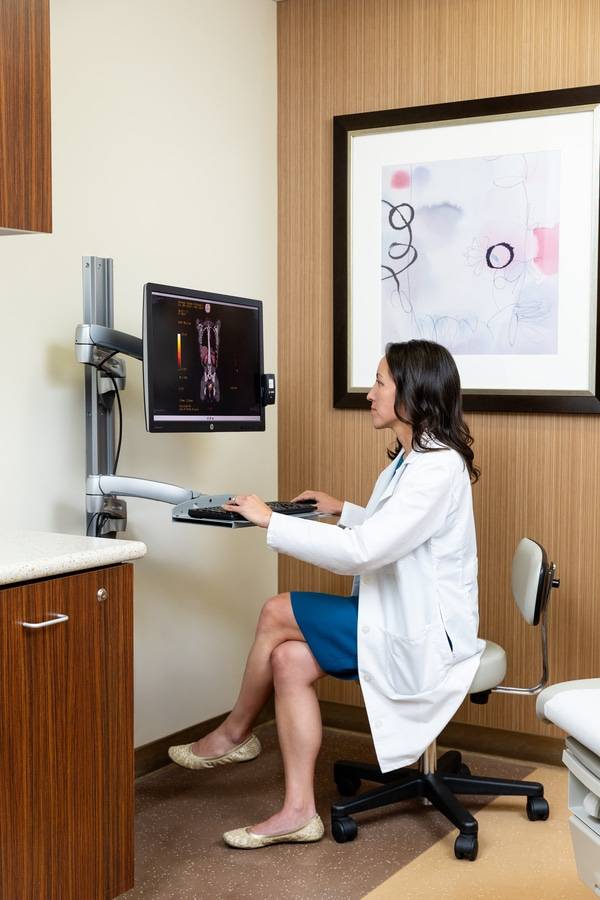
Jo Marie Tran Janco, MD, Scripps Clinic
Cervical cancer treatment and recovery
In March 2023, Farrah underwent an open radical hysterectomy, which was followed by six rounds of chemotherapy and 32 rounds of radiation treatment. The first few weeks of treatment went smoothly, she recalls, but then it got more challenging.
“At first, I thought, OK, I can put myself together and get going and do this,” Farrah says. “But by weeks three and four, it got harder.” Part of the challenge, she says, was that she was still trying to process her diagnosis. “Even during treatment, I kept thinking, Am I really the patient? I can’t afford to have this right now.”
Three weeks into treatment, she started feeling side effects. But the self-described type A personality followed all the instructions to the letter. Even in the midst of radiation and chemotherapy, she went on three walks daily, going as far as her legs would allow.
“There was nothing to do but move through it — to go with it and find routine where I could,” she says.
Dr. Janco also suggested acupuncture, which Farrah could do right at Scripps. “It was a game-changer,” she says. “It’s what got me through the last weeks of treatment.”
She also credits Dr. Janco for remaining by her side throughout the process, calling her a “champion for the whole journey.” She adds that the entire team at Scripps was instrumental in her healing.
“I was so impressed with how well they all coordinated; they all had the same game plan,” she says. “It took that worry off my plate because I felt so confident in my team.”
Life after cervical cancer treatment
After six weeks of treatment, Farrah’s care team believed the cancer was gone. But when the treatment ended and her appointments shifted from multiple times a week to once every few months — the transition was harder than she ever expected.
“Afterward, people said, ‘You did it. You’re done,’ but in my head, I wasn’t done,” she says. "I kept thinking, Am I eating right? Am I doing everything right? Everything in your life goes through a cancer-filter brain.”
She continues: “People kept telling me, ‘You’re so strong,’ and I know I am. But it didn’t always feel that way. What they didn’t see was how hard I had to fight to find that strength. Time has helped, but I also had to choose to find my way back to work, life and the world again.”
“Take an hour out of your hectic day for those yearly checkups and physicals. The alternative could potentially cost you your life or take several months of treatment to save it.”
What a cervical cancer survivor wants women to know
With many cancers, the risk of recurrence is highest in the first two years after treatment. That’s why reaching the two-year mark cancer-free is such an important milestone. Farrah hit that two-year mark last year. Although she believes she may always carry some degree of “cancer-filter brain,” reaching the milestone was “a huge relief.”
“The body just knows. When I hit the two-year mark, it felt like my body was saying, ‘OK, you can relax a little,’” she says.
Looking back on her initial symptoms — back pain and heavy periods — what strikes her now is how “subtle” they seemed compared to what was actually happening in her body.
She remembers thinking that she didn’t have time to answer the phone call from her doctor because she was on her way to a work event — as if work mattered more than her health. For her, those moments underscore the most important lesson from her experience: always make time to take care of yourself.
“Take an hour out of your hectic day for those yearly checkups and physicals,” she says. “The alternative could potentially cost you your life or take several months of treatment to save it.”

This content appeared in San Diego Health, a publication in partnership between Scripps and San Diego Magazine that celebrates the healthy spirit of San Diego.
Related Medical Services
Cancer Care

Cancer Care
Scripps Health offers advanced cancer care through an approach that combines experienced teams with the latest technologies and treatments.
Related Locations
Prebys Cancer Center

Prebys Cancer Center
4044 5th Avenue
San Diego, CA 92103

Scripps Clinic Jefferson

Scripps Clinic Jefferson
2205 Vista Way
Oceanside, CA 92054
Scripps Clinic Rancho Bernardo

Scripps Clinic Rancho Bernardo
15004 Innovation Dr.
San Diego, CA 92128
Scripps Clinic Torrey Pines

Scripps Clinic Torrey Pines
10710 North Torrey Pines Rd.
La Jolla, CA 92037

Related Providers